Updated 21 September 2026
Your tasks, in every tool you already use
What it is
Taskr has a token-authenticated REST API v1 that reaches the same data the app shows — workspaces, lists, tasks, notes, tracked time, statistics and stored files — under the same rules. Two doors into the same surface: if you write the automation yourself, the API gives you all of it, and if an AI assistant is the one doing the work, the MCP server exposes exactly that surface as tools. It is a Premium Plus and Team feature: free and Premium accounts do not have API access.
When you would use it
A deploy script that opens a task when the build fails. A weekly cron that creates the invoicing task on the first of the month. Or an AI assistant that closes off the day by reading the board and ticking what is done, instead of you retyping it. The reason to do it through an API rather than through the interface is that all three of those happen when nobody is looking at a screen.
How it works in Taskr
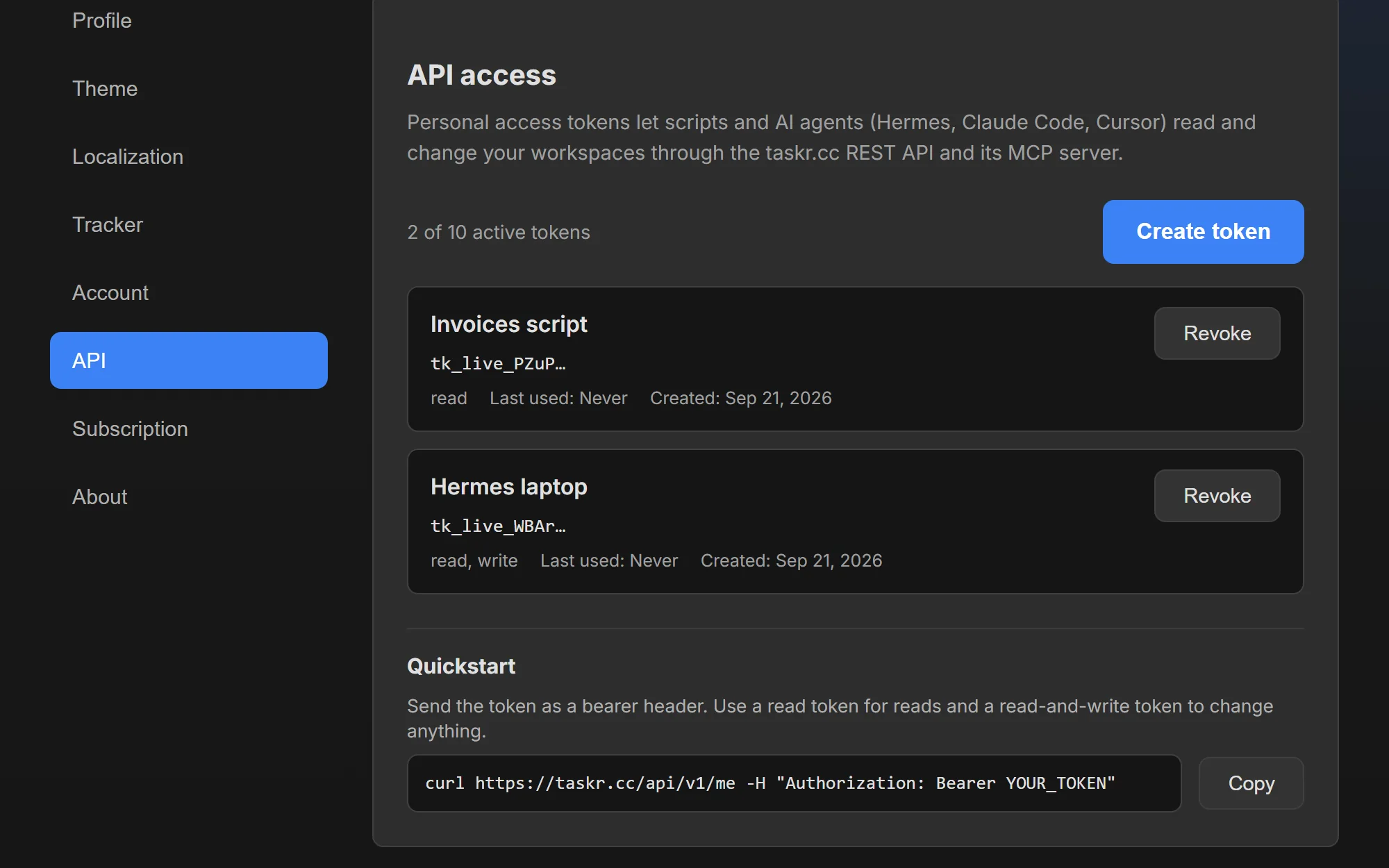
- Create a token in Settings → API. Give it a name you will recognise later (say
deploy-scriptorHermes), pick a scope — Read only or Read and write — and decide whether it expires (never, or after 30, 90 or 365 days). - Copy the token immediately. The plaintext is shown exactly once, in the confirmation dialog. Only a hash is stored, and the list shows just the prefix — if you lose it, revoke it and make another one.
- Call the API at
https://taskr.cc/api/v1withAuthorization: Bearer tk_live_…. The catalog of what exists is atGET /_tools, andGET /metells a script who it is working as. - Expect the app's own rules to apply. Permissions, plan gates and limits are enforced on the server, so a token with too little scope gets a refusal rather than a smaller result.
- Point an AI assistant at the MCP server. The server fetches the tool catalog once at startup
and registers one tool per endpoint, so what the assistant can do matches the API exactly. It
needs Node 20 or newer and two variables:
TASKR_API_URLandTASKR_API_TOKEN.
cd mcp && npm install && npm run build # -> mcp/dist/index.js
// Hermes / Claude Code / Cursor — stdio transport
{
  "mcpServers": {
    "taskr": {
      "command": "node",
      "args": ["/absolute/path/to/tasker/mcp/dist/index.js"],
      "env": { "TASKR_API_URL": "https://taskr.cc", "TASKR_API_TOKEN": "tk_live_…" }
    }
  }
}
What to watch out for
The MCP package is not published to npm yet. @taskr/mcp exists with the repository and is
verified against the live API, but it is private, so npx -y @taskr/mcp will not resolve — build the
entry point from the repository and point your client at mcp/dist/index.js, as above. A new API
endpoint only appears in the assistant's tool list after the client restarts, because the catalog is
fetched once at startup. Other limits worth knowing before you write the script: 10 usable tokens per
account (revoked and expired ones stop counting), an unverified email blocks writes, revoking takes
effect on the very next request with no cache to wait out, and requests are rate limited per token
and per account. Read-only tokens genuinely cannot write anything, including starting a timer.
Where to go next
- Time tracking, whose tracked time the API can read and start
- Markdown notes, whose notes the API can write
- Reference: the full API contract lives in the Taskr documentation
Create a free account and see whether the API fits your plan when you need it.
Ready when you are.
Create a free account